
Spunlace is a technique that uses high-pressure fine water jets (” water needles “) to spray onto a fiber web, causing the fibers to entangle with each other and thereby endowing the material with strength. Parallel spunlace and cross lapper spunlace are two key web-forming methods in this technology, which determine the arrangement of fibers and the performance of the final product.
I. Detailed Explanation of Processes and Equipment
1. Parallel Spunlace
• Core concept: The fibers are basically arranged in a single direction (mainly along the direction of machine operation).
• Key equipment and processes:
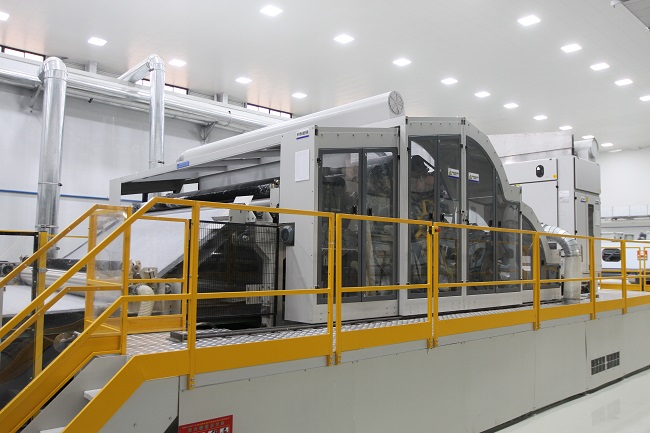
Carding into a web: The fibers are carded by a carding machine into a thin web of fibers arranged in parallel (single-layer fiber web).
Parallel stacking: Parallel fiber nets combed out from multiple layers are stacked and laid layer by layer on the conveyor curtain to form a fiber net of a certain thickness. When stacking, the fiber directions of each layer are basically the same.
Spunlace entanglement: After being laid, the fiber web enters the spunlace area and is sprayed from the front and/or back of the high-pressure water needle, causing the parallel-arranged fibers to entangle with each other in the vertical direction.
• Equipment features: The production line is relatively simple, with the core components being the carding machine and the net laying machine (parallel net laying). The pressure of water spikes is usually relatively high to make up for the deficiency of lateral strength.
2. Semi-crossed spunlace, fully crossed spunlace
• Core concept: The fibers are arranged in a crisscross pattern in multiple directions, resulting in a more uniform structure.
• Key equipment and processes:
Carding into a web: Similarly, it is first carded into a thin layer of parallel fiber web by a carding machine.
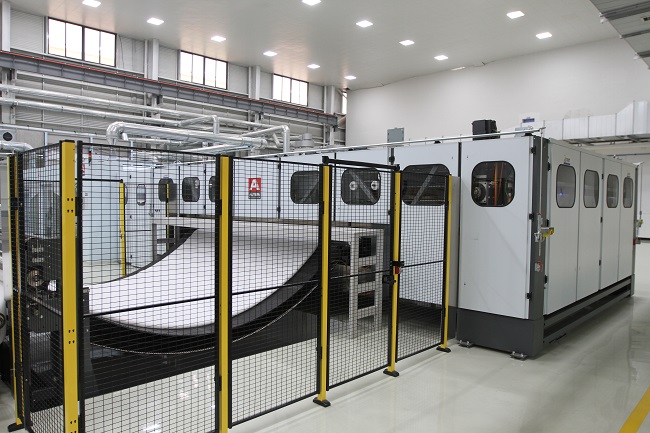
Cross-laid net: This is the most fundamental difference from flat laying. Through a high-speed swinging net laying machine, the thin net sorted out is reciprocally folded and laid on the conveyor curtain in a “Z” shape. In the fiber web formed in this way, the fiber directions are cross-mixed.
Spunlace entanglement: The cross-laid fiber nets enter the spunlace area for entanglement. Because the fibers themselves have already crossed, the structure becomes more stable after entanglement.
• Equipment features: The production line has added a complex cross net laying machine. The formed fiber web is wider, has a wider range of grammage and better uniformity.
Ii. Comparison of Two Technologies and Product Performance
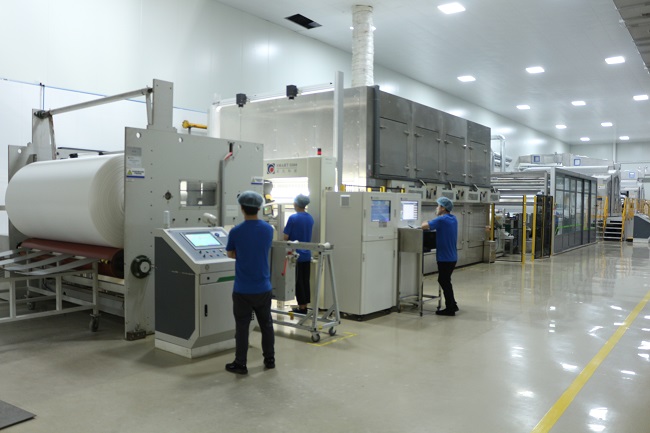
It should be noted that for parallel spunlace, one carding machine and one web forming machine are used; for semi-cross spunlace, two carding machines and one web forming machine are used; and for full cross spunlace, two carding machines and two web forming machines are used.

Iii. Application Fields
Due to performance differences, the application fields of the two are significantly distinct:
• Application of parallel spunlace fabric:
The field of wiping cloths: It is its largest market. Especially high-performance electronic display screen wiping cloths. Because its fibers are arranged in parallel, the surface is smoother, less likely to scratch the screen, and has strong decontamination power.
Medical hygiene materials: disposable medical protective materials such as surgical gowns and drapes. It is required to have high strength, no shedding, good barrier property, and the flat laying structure can meet the requirements.
Leather base fabric: Used as the bottom layer of artificial leather/synthetic leather, it requires dimensional stability and high strength.
Interlinings for clothing: used for suits, shirts, etc., they should be firm and not deform.
• Applications of cross lapper spunlace fabric:
Dry and wet wipes field: The main base material of wet wipes. Because of its softness, fluffiness, good liquid absorption and isotropy, it offers a better user experience.
Beauty care: Mask base fabric, makeup cotton, makeup remover cotton. It is required to be extremely soft, skin-friendly and water-locking.
Household cleaning: High-quality dishcloths and scouring pads. It combines softness and wear resistance.
Medical dressings: wound contact layers, bandages. It should be soft, non-stick to the wound and have good absorbency.
High grammage fields: suede imitation leather, decorative materials, filter materials, etc.
Iv. Development Prospects and Trends
1. Continuous market growth: Globally, with the enhancement of hygiene awareness and the popularization of disposable products, the spunlace nonwoven fabric market, especially for wiping cloths and medical materials, will continue to grow steadily.
2. Expansion of application fields
High-end wiping: In fields such as industrial precision instruments, optical lenses, and new energy vehicles, the performance requirements for parallel spunlace wiping cloths are even higher.
Sustainable products: Flushable and biodegradable wet wipes pose new challenges and opportunities for the raw materials and processes of cross lapper spunlace fabrics.
New medical and personal care: High-end applications such as tissue engineering stents and advanced drug-device combination dressings are under exploration.
3. Positioning of the two technologies:
Parallel spunlace will continue to dominate in the fields of high strength, high performance and special purposes, and will develop towards ultra-fine, ultra-smooth and functionalized directions.
Cross lapper spunlace will continue to be the main force in mass consumption of hygiene products that emphasize soft and comfortable experiences, and will develop towards being ultra-soft, ultra-thick and degradable.
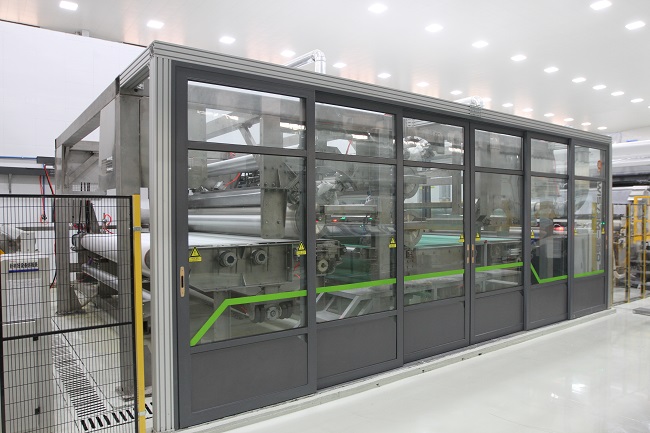
In summary, parallel spunlace and cross lapper spunlace are complementary rather than competitive, and together they constitute the vast application territory of spunlace nonwovens. The core of future development will revolve around “functionalization, differentiation and greenization” to meet the increasingly segmented and upgraded market demands.
If you are interested in CTMTC’s business areas, cooperation models or service contents, and are eager to explore more cooperation possibilities, please feel free to contact us at any time!
Post time: Dec-11-2025