
FDY is commonly referred to as fully drawn yarn. It is a finished fiber product formed by the combined process of one-step spinning and stretching. Its strength and elongation and other indicators are relatively stable, and it can usually be directly used for weaving or knitting and other processing. The FDY filament production line achieves the transformation of solid polyester chips into high-performance and directly applicable textile raw materials through a series of precise control unit operations such as melting, precise metering, extrusion, cooling, high-speed stretching, heat setting, and stable winding. The core feature is that during the spinning process, the yarn strip completes the entire process from melt to high-tension and high-crystallinity finished fiber in a single continuous procedure of spinning, stretching, and winding.
I. Overview of the Process Flow of the FDY Production Line
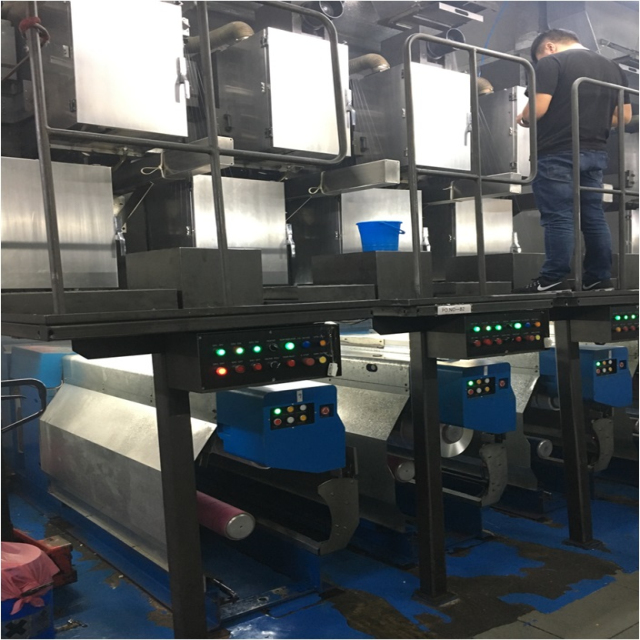
The FDY production line is a highly integrated and automated continuous process, mainly divided into the following systems:
1. Raw Materials and Transportation System
• Raw Materials: Mainly use polyester chips, with uniform characteristic viscosity and moisture controlled within the process requirements.
• Process: The chips are transported through pipelines by pneumatic force to the silo, and then enter the crystallization drying tower. In the drying tower, the chips are first heated and crystallized (to prevent adhesion during drying), and then deeply dried by high-temperature dry air to remove moisture. This is the basis for ensuring smooth spinning and the quality of the finished product.
2. Melt Extrusion System
• Process: The dried chips are fed into the screw extruder.
• Key Equipment: Screw Extruder.
• Process Points: The screw has multiple heating zones, and the temperature is precisely controlled above the melting point of PET. The chips are heated, compressed, melted, and homogenized under the rotation and advancement of the screw, forming a uniform and stable melt.
3. Melt Transportation and Metering System
• Process: The melt enters the spinning box from the screw extruder.
• Key Equipment: Metering Pump (Gear Pump).
• Process Points: The metering pump operates at an extremely precise speed and flow rate, delivering the melt quantitatively and under pressure to the spinning components. This is the key to ensuring uniform filament fineness.
4. Spinning and Cooling Forming System
• Key Equipment: Spinning Components, Side Blowing Window.
• Process: The melt passes through the filter medium and spinneret in the spinning components, and is extruded from the micropores to form a melt stream. The stream immediately enters the side blowing chamber, where it cools under controlled temperature and humidity in the clean cooling air, solidifying into a solid filament strand. Oil Application: Below the cooling window, the filament bundle is uniformly coated with spinning oil by the oil nozzle to impart its anti-static, smooth, and cohesive properties.
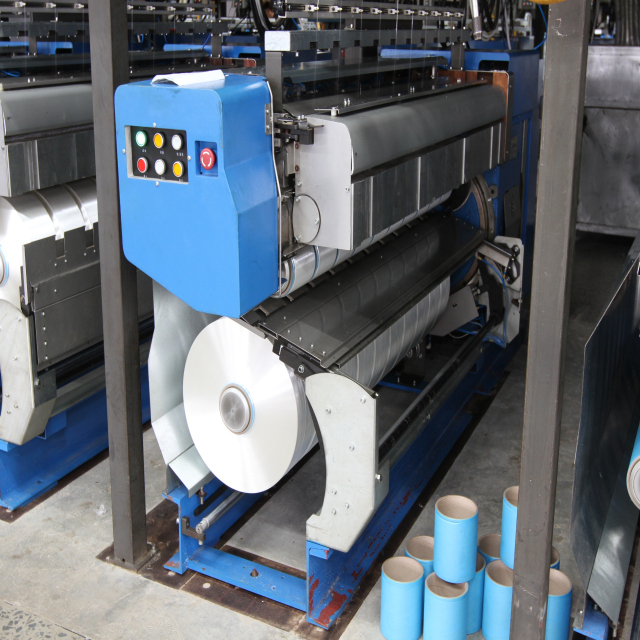
5. Stretching and Heat Setting System (The core of the FDY process)
• Key Equipment: GR1 (First Guide Wire Roller), GR2 (Second Guide Wire Roller), Heat Roll.
• Process:
Pre-stretching: The filament strand is first wound around GR1 at a certain speed V1.
Main Stretching and Heat Setting: The filament strand then winds around the higher-temperature GR2, with its linear speed V2 much greater than V1. The stretching ratio = V2 / V1. Under this speed difference and the high-temperature effect of GR2, the filament strand is instantaneously stretched significantly, with molecular chains orienting and aligning along the fiber axis and undergoing crystallization, thereby achieving high strength and low elongation characteristics.
Relaxation Heat Setting: Some production lines also have GR3 after GR2, with a speed V3 slightly lower than V2 and equipped with independent temperature control, used to stabilize the fiber structure and improve the uniformity of dyeing.
6. Spooling and Forming System
• Key Equipment: High-speed Spooling Head.
• Process: After thorough stretching and heat setting, the filament strand is passed through the networker (with compressed air introduced to make the single filaments intertwine and increase cohesion) and then is spooled by the high-speed spooling head into a tube yarn. The spooling forming must be good to ensure smooth subsequent unwinding.
II. Main Application Domains of FDY
Thanks to its excellent mechanical properties and fabric style, FDY is one of the most widely used fiber raw materials.
• Clothing Fabrics:
Silk-like fabrics: Weave with fine/desized FDY yarns, resulting in soft, flowing, and elegant fabrics suitable for women’s clothing, shirts, and dresses.
Springy-spun, peach-patent, Tencel, etc.: Often interwoven with other fibers such as DTY to form the smooth surface of the fabric, providing a framework and luster.
Linings: Main raw material for high-end clothing linings (such as polyester taffeta).
• Home Textile Decoration:
Curtains, window screens: Utilize its good drapability and luster.
Bedding: As the fabric or lining for pillowcases, bed sheets.
Cushion cover, decorative fabric.
• Industrial Textile Products:
Sewing thread: High-strength FDY is the main raw material for high-quality sewing threads.
Tents, canvas, advertising fabric: High-strength thick-fiber FDY can be used for industrial fabrics.
Coated base fabric.
• Others:
Plain weave and twill weave fabrics.
As warp yarn, combined with spandex to form elastic fabrics.
If you are interested in learning about the business scope, cooperation model and service details of CTMTC, and if you wish to explore more cooperation opportunities, please feel free to contact us at any time!
Post time: Jan-21-2026