
Hemp, as a renewable bio-based material with multiple advantages such as environmental friendliness, toughness, and breathability, has a cellulose content of over 70%. Its tensile strength is 8 times that of cotton, and it possesses excellent moisture absorption, sweat release, antibacterial, anti-static, and high-temperature resistance properties. It is an important raw material for promoting the green transformation of the textile industry. However, the non-cellulose gels such as pectin, hemicellulose, and lignin contained in the raw hemp of hemp restrict its industrialization development. A high-quality hemp degumming production line is the key to unlocking the value of hemp fibers. The core of the hemp degumming production line is to remove the non-cellulose gels such as pectin, hemicellulose, and lignin from the raw hemp, separating the tough raw hemp stems and skins into soft and spinnable refined hemp. CTMTC has built a full-process standardized system from raw material pretreatment to post-treatment based on its over 40 years of technical accumulation in the textile machinery field.
1. Complete production process
Firstly, raw material pretreatment. The raw hemp is sorted, cut, pre-immersed, and impurities such as moldy and impure substances are removed. It is cut to a standard length of 30-50 cm and fully moistened to lay the foundation for subsequent degumming; then it enters the core degumming process, where specialized processes are used to decompose the gels; after degumming, it goes through water washing purification, mechanical fiber separation, bleaching and conditioning, oil application softening, dehydration and drying, and finally becomes refined hemp products with a residual fiber rate of less than 2%, meeting the white standard, and soft and spinnable. The entire process takes into account production efficiency, product quality, and green environmental protection requirements.
II. Core Processes
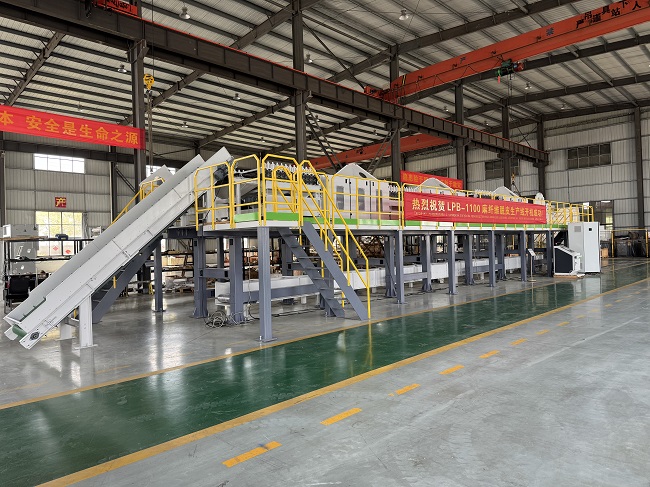
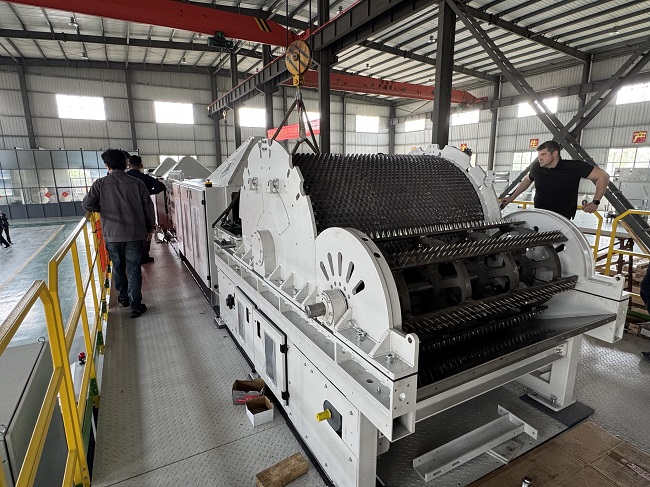
The main equipment of the hemp degumming production line includes a hemp fiber elevator, a rolling mill, a horizontal vibrating hemp conveyor, an inclined vibrating hemp conveyor, a shredder, a sealed pressurized alkali cooking pot/high-pressure degumming kettle (chemical degumming), a biological enzyme degumming reaction tank/constant temperature fermentation tank (biological/composite degumming), a bleaching machine, drying equipment, a finished product combing machine, and a packaging machine.
1. Raw material pre-treatment: Sorting of raw hemp, cutting into sections, loosening, spraying pre-wetting, removing hemp stems, mud, and other impurities, ensuring uniformity of the material.
2. Pre-treatment in advance: Acid immersion/soaking, softening the gel structure, enhancing the penetration ability of the solution, reducing the subsequent degumming load.
3. Core degumming process: Using chemical/biological/composite processes to decompose pectin, hemicellulose, lignin, etc. of the gel.
4. Multi-stage water washing: Counter-flow circulating water washing, removing decomposed gel and residual chemicals, reducing pollution.
5. Mechanical fiber breaking: Mechanical fiber breaking and kneading, peeling the hemp core, gel residue, dispersing the fiber bundles.
6. Bleaching and conditioning: Bleaching and refining oxidation decolorization, reducing the lignin content, improving the fiber whiteness and spinning performance.
7. Softening process: Neutralization and softening weak acid to neutralize residual alkali, adding softening additives, improving the fiber feel and toughness.
8. Post-treatment: Drying, loosening, drying, shaping, making qualified and dry hemp.
III. Application Areas
Relying on a complete equipment supply and technical service system, the hemp degumming production line of CTMTC has achieved diversified applications, covering fields such as textiles, automobiles, construction, and special materials. In the textile industry, refined hemp can be made into high-end fabrics, home textiles, etc., with excellent breathability and antibacterial properties; in the automotive industry, hemp fiber composite materials can achieve weight reduction of the vehicle body, meeting the green transformation needs of the automotive industry; in the construction industry, the boards made from hemp have significantly improved insulation performance compared to traditional materials, being environmentally friendly and durable; in addition, in the papermaking and medical material fields, hemp fibers also show broad application prospects.
IV. Company Introduction
CTMTC was founded in 1984 and is the largest professional import and export enterprise in the field of textile machinery in China. With rich international trade experience, professional textile machinery technical capabilities, and localized marketing service networks, CTMTC has established extensive cooperative relationships with customers in over 50 countries and regions around the world, including Turkey, Egypt, Pakistan, Vietnam, and Indonesia, and has accumulated rich international cooperation experience. Delving deeply into the hemp degumming production line field is not only an important measure for CTMTC to expand its natural fiber processing equipment business, but also a concrete practice of implementing the green development concept and promoting the green and low-carbon transformation of the textile industry.
Post time: May-14-2026