Wet-laid Spunlace is a nonwoven manufacturing process that combines the wet papermaking process of forming a web with high-pressure water lapping. Its core advantages include high utilization rate of staple fibers, uniform fiber network, soft feel, good moisture absorption, and it is mainly used in wet wipes, masks, medical dressings, filtration materials, etc. CTMTC, with a profound understanding of the process, has established a full-process standardized system from raw material processing to finished product winding, cutting, and packaging. The specific process and core techniques are as follows:
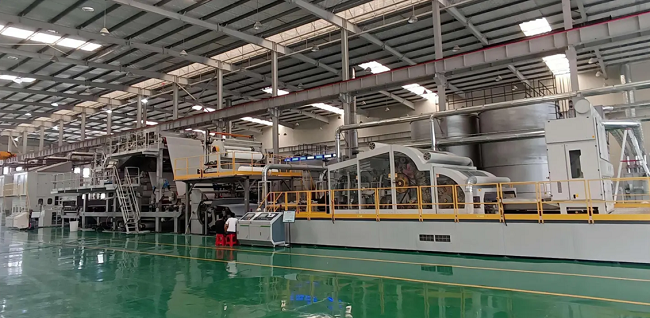
I. Complete Production Process
Firstly, wood pulp, polyester, viscose and other fiber raw materials are mixed with water to form a slurry. This slurry is diluted and homogenized, and then dehydrated through a forming net to form an initial fiber web. Subsequently, the fiber web is transferred to the water injection zone and receives vertical spraying from multiple rows of high-pressure fine water needles. Under the action of the puncturing and rebounding of the water needles, the fibers fully entangle and reinforce each other, thereby achieving strength. Finally, through efficient vacuum dehydration and drying processes, a tightly structured and soft-textured wet water injection non-woven fabric is produced.
II. Core Process Analysis
The core process can be summarized into four key steps, and CTMTC precisely controls each of them.
1. Pulp Preparation: The foundation for ensuring product uniformity.
This step involves uniformly dispersing the fibers. Dry fiber raw materials are forcefully disintegrated into single fibers in a hydraulic pulping machine, forming a pulp. After dilution, concentration adjustment, and precise filtration, the pulp becomes a stable, impurity-free suspension.
2. Net Formation: Ensuring isotropy (consistent properties in all directions) and high uniformity for wet products.
This step is the process of converting the pulp into a fiber net. The uniform pulp is precisely spread onto a moving forming net through a flow box. Under the gradient suction of a vacuum dehydration device, the moisture is rapidly removed, and the fibers deposit on the net surface, forming a continuous wet-state fiber net with three-dimensional random arrangement of fibers.
3. Consolidation: Precisely regulating the tightness, feel, and strength of the product.
This step is the process of water injection bonding. The wet fiber net enters the core consolidation area, and high-pressure water passes through the micropores on the water injection head to form dense water needles that penetrate the fiber net vertically. The impact force of the water needles drives the fiber displacement, flipping, and forming reflected water flow on the supporting net curtain, prompting the fibers to interweave and connect with each other, thus forming a firmly bonded whole through purely physical action.
4. Finishing: Drying and setting.
The wet fabric sheet after consolidation is sent to the drying system (commonly a hot air penetration type) for removing residual moisture and achieving setting. Subsequently, surface treatments such as rolling can be carried out as needed, and finally, it is wound up by the winding machine to form the finished product.
Other systems support: Water circulation and control.
The process water is collected, filtered, and reused in a closed-loop white water system to achieve water conservation and environmental protection. The entire production line is centrally monitored and automatically adjusted by a central control system to ensure stable parameters in each step, guaranteeing the quality and efficiency of continuous production.
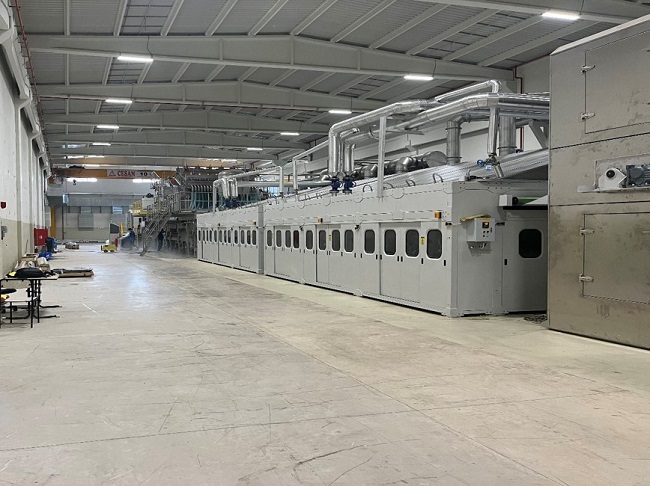
In summary, CTMTC delivers a verified, fully functional process capability and equipment system that can consistently achieve the entire process from raw material processing to finished product winding, cutting, and packaging. Our wet-spun felting one-stop solution directly addresses the core needs of clients for enhancing competitiveness and achieving sustainable development. If you are interested in CTMTC‘s business areas, cooperation models, or service contents, and are eager to explore more potential for cooperation, please feel free to contact us at any time!
Post time: Apr-27-2026